The Neapolitan who draws a wedding by hand before anyone knows whether it can be built.
By The LWD Edit · 28 August 2026 · 5 min
Scroll
The only published endorsement Dario Varsalona has is not from a couple. It is from a collaborator, a woman named Alessandra who helped plan one of his weddings and then wrote about it afterwards. What she chose to describe is telling. Not the flowers, not the food, not the couple. The drawings. She watched the wedding travel from his first hand-drawn sketches to structures her fellow guests could not believe had been built, and that sequence is the whole of what this studio is.
Most wedding planning runs the other way. You find a venue, you learn its constraints, you assemble a look from what suppliers can deliver into that room on that date. It is a sensible way to work and it produces sensible weddings. Varsalona starts with a drawing made before anyone knows whether the thing exists, which is a considerably less sensible way to work, and it only functions because of a decision he made about the shape of the business.
The bar, monogrammed, lit from below
The seating plan, monogrammed
The studio lists eleven disciplines: wedding design, event management, graphic design, space design, floral design, architecture, 3D design, light design, video, photography and set design. Not eleven suppliers on a preferred list. Eleven disciplines in house, under one roof. That is unusual to the point of being eccentric in a trade built almost entirely on subcontracting, and it is the only way a hand-drawn set survives contact with a real venue and a real deadline. If you draw a mirrored aisle laid across standing water, somebody has to actually build standing water.
"Scenari realizzati seguendo la naturale inclinazione verso uno stile sofisticato, essenziale, dalle forme pulite e lineari: un lusso velato che si palesa mediante la raffinatezza dei dettagli."
That line is his, and the translation matters: scenes built towards a sophisticated and essential style, of clean and linear forms, a veiled luxury revealed through the refinement of the details. It sounds like the usual thing until you look at the work, and then it turns out to be a precise technical description. The rooms are not busy. The forms underneath are simple, often severe. What makes them read as opulent is the detail sitting on top, and the detail is where the money and the hours went.
The civil ceremony, sash and signatures
Under the floral canopy, the register signed
He came to it sideways and late, which is the part of the story he tells himself. He was born in Naples in December 1983. In 2008 he went to the Tutto Sposi fair at the Mostra d'Oltremare, the sort of thing you attend once out of curiosity, and it did not leave him. Three wedding planning courses followed, one of them with Cira Lombardo, who then let him assist on her events. Later he worked alongside Massimo Iodice, the Neapolitan florist. That is an apprenticeship in the proper sense, served in the city, under people who already had reputations to protect.
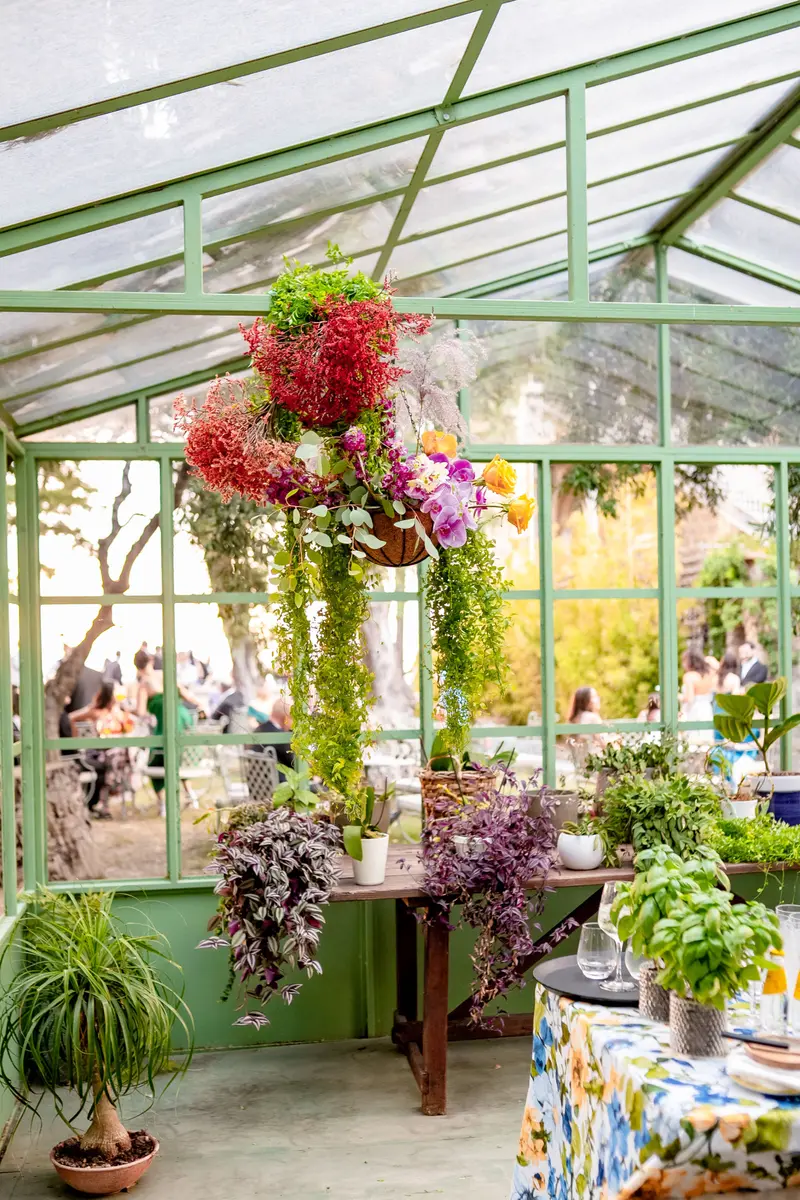
The florals explain themselves after that. Ceilings of white blossom, tunnels of lit foliage with a bride at the far end, banks of peony deep enough to hide a stage. The floral discipline is in house because he learned it from a florist rather than hiring one, and the difference shows in the way flowers are treated as architecture rather than decoration. They hold up ceilings. They make corridors. They are structural.
A white corridor of orchids, and the walk through it
What is missing from his own presentation is stranger. His website has no wedding portfolio at all. The portfolio page renders empty. There are seven photographs on the entire site and five of them are a Philipp Plein fashion event. His video page features a costumed historical entertainment piece and two parties, and leaves his actual wedding films unlinked on a channel nobody visits. The Instagram handle printed on his own site is dead and has been for some time; the live account is a different one. This is a designer who has built a genuinely serious studio and then declined to show anyone.
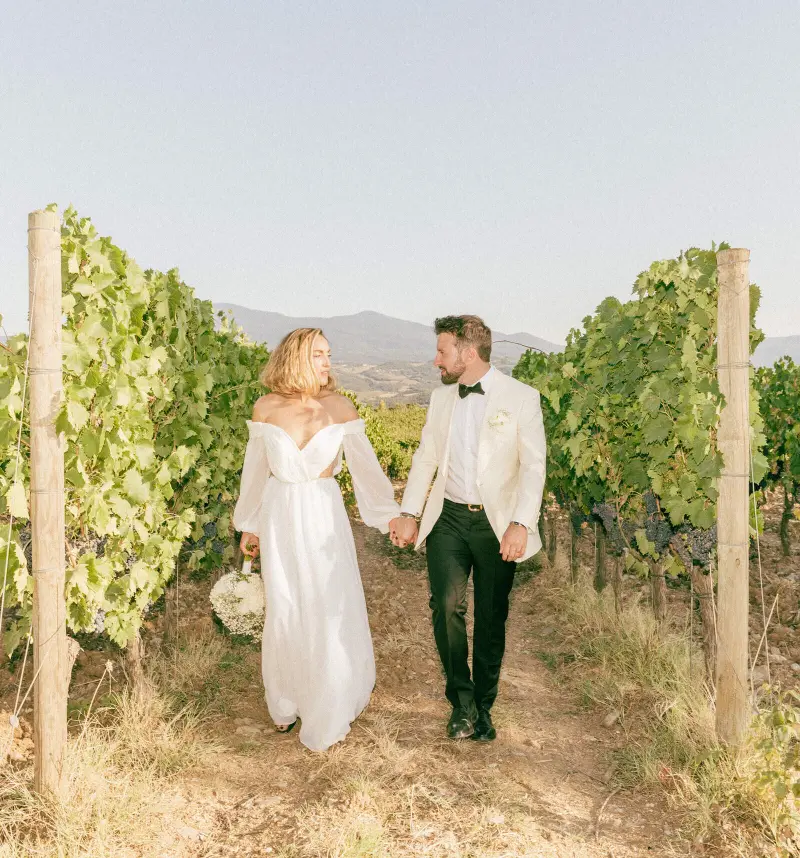
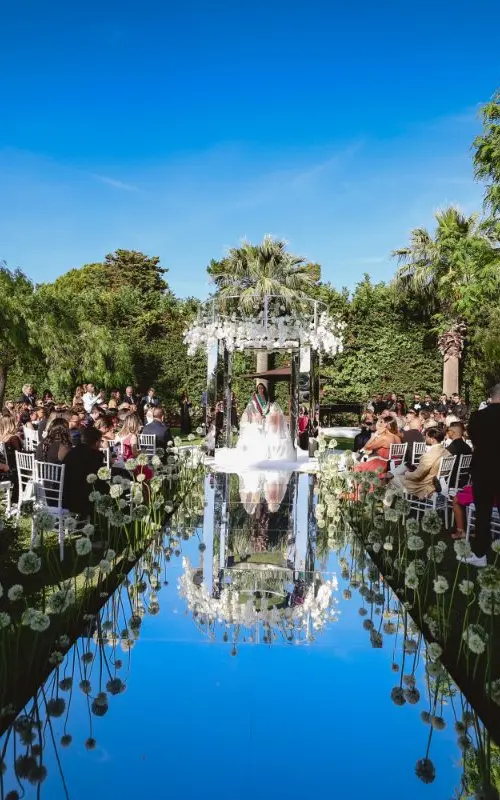
So the work has to be found elsewhere, and when you find it the gap between the presentation and the product is almost funny. There is a wedding, monogrammed A and R throughout, that runs to a ceremony aisle laid across mirrored water under palms, a cake built as a lit staircase with sparklers at the top, fireworks over a garden, live dancers on a stage above a bank of white flowers, a corridor of white orchids, and a first dance a foot deep in dry ice. It is theatrical without apology, and the restraint in the forms is what stops it tipping into spectacle for its own sake.
What It Costs
Nothing is published, anywhere. Not on his site, not on his listing, not on the Italian directories, and his 5 Star pricing tab renders empty rather than saying anything at all. The only quantified thing on offer is effort: between sixty and two hundred and fifty hours go into a single event. Given the order of operations, that figure is at least honest. You cannot cost a wedding that does not exist yet, and he does not draw one until you have asked him to.
The reach, in his own words, is Naples and the wider Campania region primarily, with availability across Italy and internationally. The films bear that out: Villa Campolieto at Ercolano, Villa Aragonese in Naples, STONE at Castellammare, and La Canzone del Mare on Capri, which is an hour from the studio and an entirely different proposition. No specific overseas market is named, so none should be assumed.
It is worth being plain about where he actually is, because the name invites a guess. Varsalona is a Sicilian surname and he is not Sicilian. He was born in Naples, the studio is on Via Galileo Ferraris in Naples, his own listing describes him as Naples-born and bred, and every piece of work anyone can point to sits in Campania or a short hop from it. The apprenticeship was Neapolitan, the florist he learned under was Neapolitan, and the output has never left.
That rootedness is doing more work than it looks. Naples is not a wedding market in the way Tuscany or the Amalfi Coast are markets: it has not been landscaped for foreign couples, and the supply chain has not been rebuilt around them. A studio working there is not choosing from a curated list of villa venues with in-house coordinators and English-speaking account managers. It is working the actual city, which is harder, and which is why the eleven in-house disciplines stop being an affectation and start being the only way the job gets done at all.
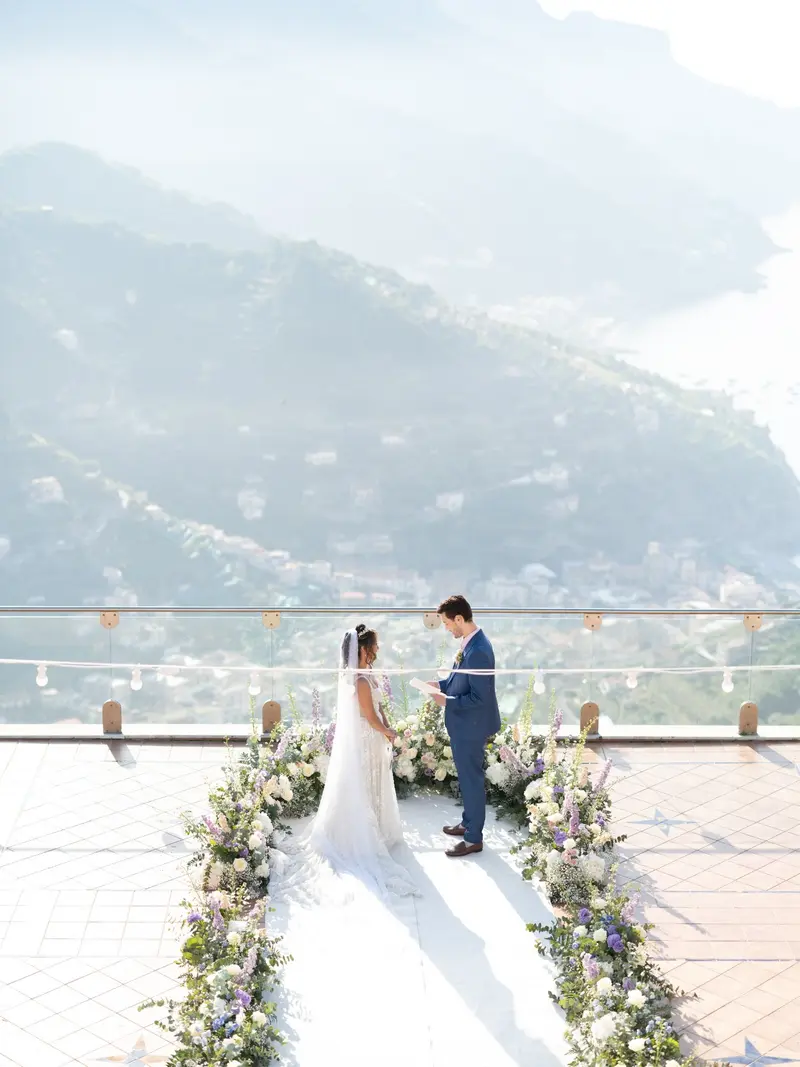
The A and R wedding is the clearest evidence of what that buys. Look at the sequence rather than the individual frames: a garden ceremony on mirrored water, a civil registrar in the tricolour sash, a monogrammed bar, a corridor of white orchids, a blossom ceiling, live dancers, a staircase cake under fireworks, and then a first dance in dry ice. That is not a wedding with entertainment bolted on at the end. It is a single continuous piece of theatre with a wedding inside it, and every one of those elements came out of the same building.
It is also, notably, a wedding of two brides: the ceremony photographs show two women, both in white bridal gowns and veils, seated together at the signing table hand in hand, an Italian civil registrar in the tricolour sash officiating beside them. Nothing in his own material makes a point of it, which is its own kind of statement in a trade that still tends to either ignore same-sex weddings or turn them into a category.
There is a risk in all of this that is worth naming. A studio that draws first and costs later is asking for trust before it has shown you a number, and a studio that builds its own sets is carrying the risk of the build rather than passing it to a supplier who can be blamed later. Both of those are uncomfortable for a couple planning from abroad, and neither is softened anywhere in his material. He does not publish a price, he does not publish a portfolio, and he does not explain the process. You are expected to look at the work and decide.
That will not suit everyone, and it is not meant to. The couples this fits are the ones who arrive with a feeling rather than a Pinterest board and want somebody to turn it into a room. The ones who want a fixed menu of packages, a rate card and a published timeline should book elsewhere, and would be happier for it. What is on offer here is a designer with a set-building capability behind him, and the whole proposition rests on whether you want the thing he draws.
What you are hiring, then, is not a planner in the usual sense. It is a production house with a designer at the front of it, one that will draw your wedding before it knows whether it is possible and then employ the eleven people needed to make it possible anyway. That is an expensive way to run a business and a slow way to sell one, which is probably why the website is the way it is. The drawings were always going to matter more to him than the marketing.
Credits
Design and production
Dario Varsalona
Based
Naples, Campania, Italy
Website
dariovarsalona.com
Written by
The LWD Edit
The editorial team at Luxury Wedding Directory, profiling the world's finest wedding venues and creatives.
Filed under
Share
Dario Varsalona · Enquire
Enquire with Dario Varsalona
Send an enquiry and our wedding team will connect you with the venue.
We use essential cookies to make our site work, and optional cookies to personalise content and improve your experience. By clicking Accept All, you agree to our use of cookies. · Cookie Policy