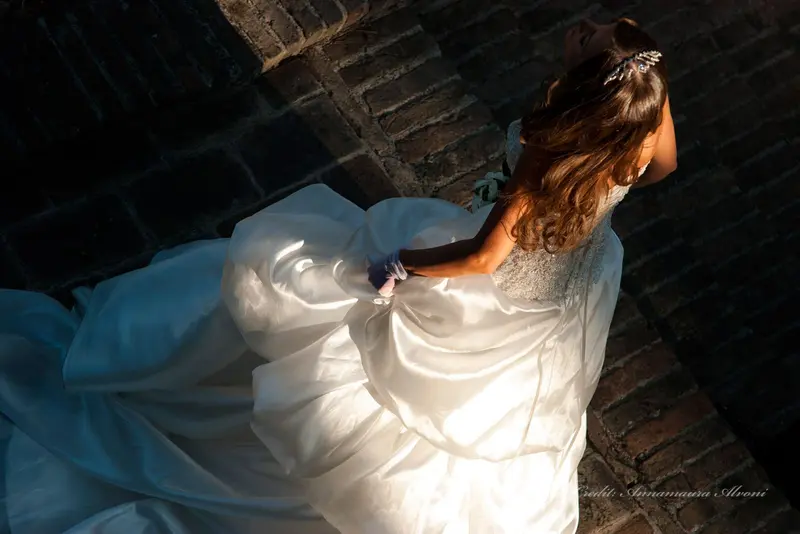
A destination wedding planner who publishes her fees, caps herself at ten weddings a year, and designs from the building rather than from a mood board.
By The LWD Edit · 28 August 2026 · 5 min
Scroll
Ask a luxury wedding planner in Italy what they charge and you will usually be invited to a call. Elisa Prati Wedding Italy publishes four numbers on a page of her own website, in euro, plus VAT, with a line underneath saying what they do not cover. An elopement of two to six people starts at 5,200. A micro-wedding of seven to thirty starts at 6,400. A single-day wedding starts at 9,000, and a multi-day celebration at 11,900. Each figure is the fee for design, planning and coordination, and the venue, the florist and every other supplier are quoted separately, which is stated on the same page rather than discovered in month four.
Elisa Prati Wedding Italy
That is not a small thing in this market, and it is not the only number she publishes. On her directory listing, answering a question about capacity, she writes that she confirms a maximum of ten weddings per year. Not around ten. Not a select few. Ten, as a ceiling she has set for herself, so that she can be present through the planning rather than distributing it across a team. Read the two disclosures together and the shape of the business is fully visible before you have spoken to anyone: a fixed fee that does not rise with your budget, and a diary that runs out.
Elisa Prati founded the agency in 2014 and works from Merate, a town in the province of Lecco, halfway between Milan and Lake Como. She has planned and directed more than eighty weddings since. Before events she worked in the fashion and graphic design industries, and that is the part of the biography that matters, because it is where the eye comes from. She describes herself, on her own About page, as a creative spirit in love with Italy, art and beauty, which is the kind of sentence that usually means nothing. In her case the work underneath it is specific enough to check.
⤢
⤢
⤢
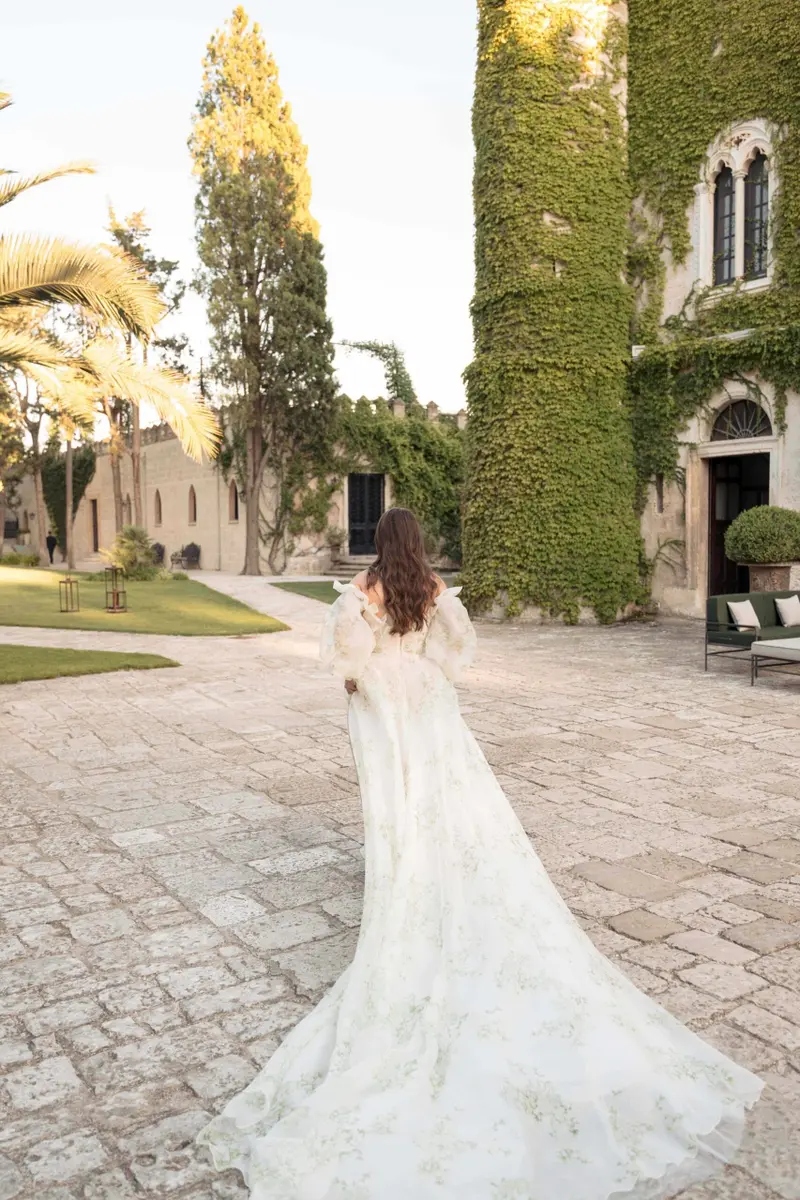
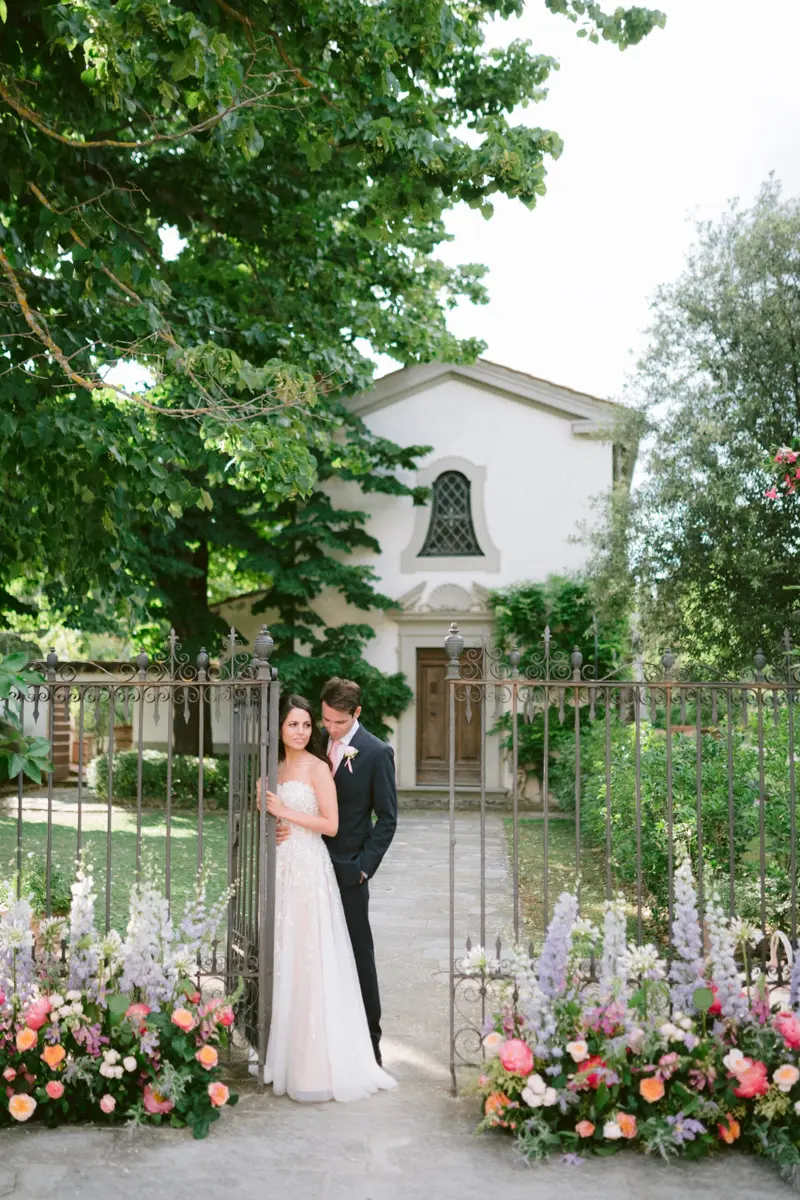
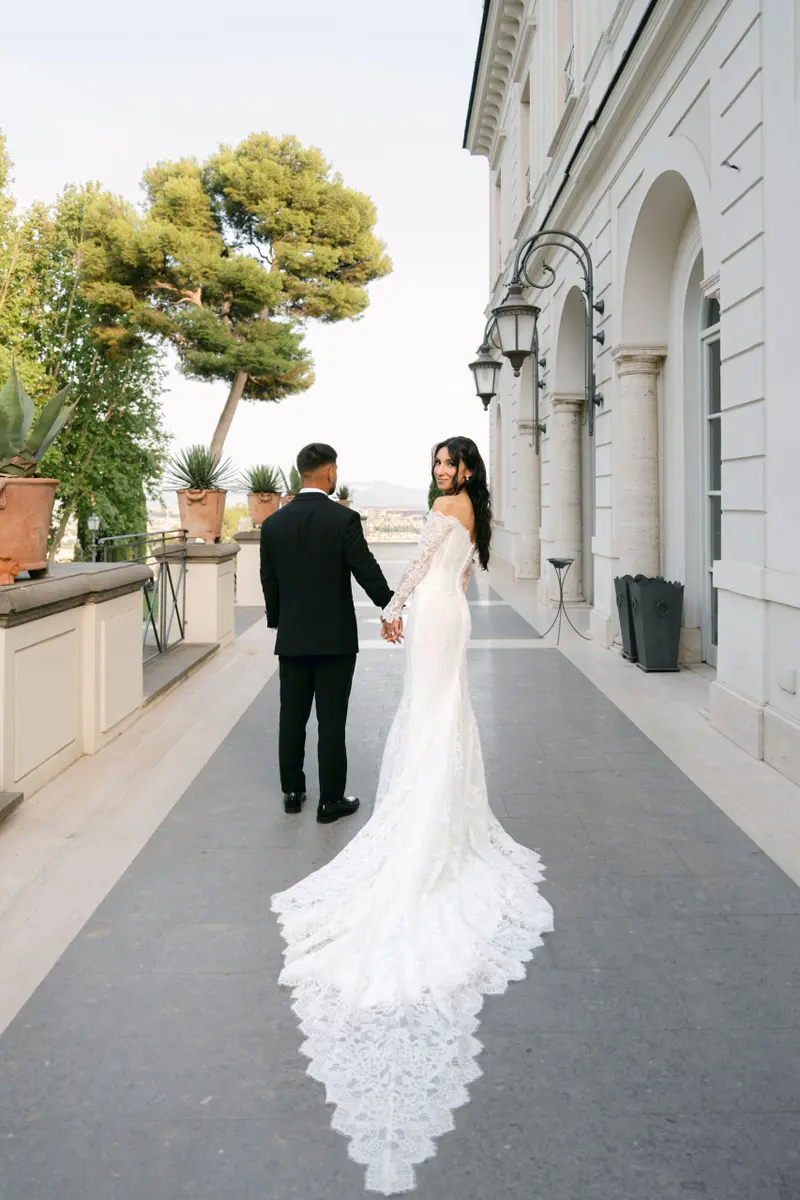
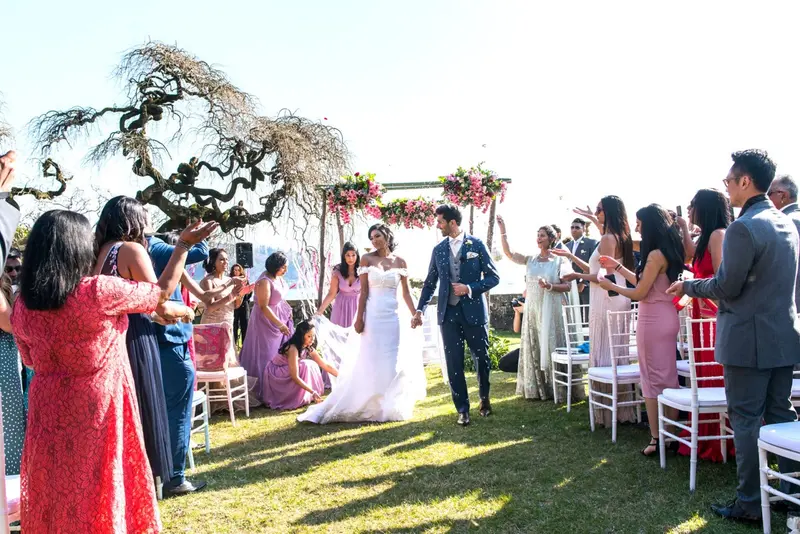
What you notice across the portfolio is that the register changes with the place, and changes properly rather than cosmetically. A ceremony in a Tuscan garden between cypresses, with dark bouquets and hard shade, is not the same event as a whitewashed courtyard in Puglia with the tables laid around an olive tree and the evening running late. Neither is the same as a frescoed hall on Lake Como where the chandeliers are already installed and the correct move is to lay the table pale and low and get out of the room's way. Three weddings, three logics. Most planners have one and rotate the flowers.
Her own phrase for the alternative is less diplomatic. Among the nine values listed on her site is a line that reads: nonconformist, I don't follow trends or Pinterest themes. It could be posture. It is testable, though, because the portfolio is public and it does not repeat itself. The two frames that survive longest are the ones with the least floristry in them: a long table set against a stone farmhouse in Sicily, and a Puglian courtyard where the architecture is doing the work and the table has been left plain on purpose.
She organises the design brief itself around the five senses, and unusually she publishes the framework rather than keeping it as an internal method. Sight is the location, the decor and the lighting design. Taste is the menu and the pairings, built with local chefs, down to olive oil tastings. Hearing is the music, specified to the room rather than booked as a band, from traditional ballads to instrumental serenades. Touch is linen, ceramics and the handmade table settings. Scent is floral installation, herb-infused settings and, if a couple wants it, a fragrance consultation for the day itself. It sounds like a brochure device until you read it back as a checklist, at which point it is simply a planner refusing to let four of the five senses look after themselves.
The reception in black and white, guests seated under strung lights, Puglia
The map is ten destinations and she publishes every one: Lake Como, Portofino, Venice, Tuscany and Florence, Rome, the Amalfi Coast and Capri, Puglia and Sicily. Lake Como is home water, which matters more than it sounds. Villa del Balbianello and Villa Balbiano are on that lake, and so is the northern supply chain, the florists and the lighting and the hire companies and the people who have to get a marquee down a private road. A planner who lives among her suppliers is on the useful side of the problem.
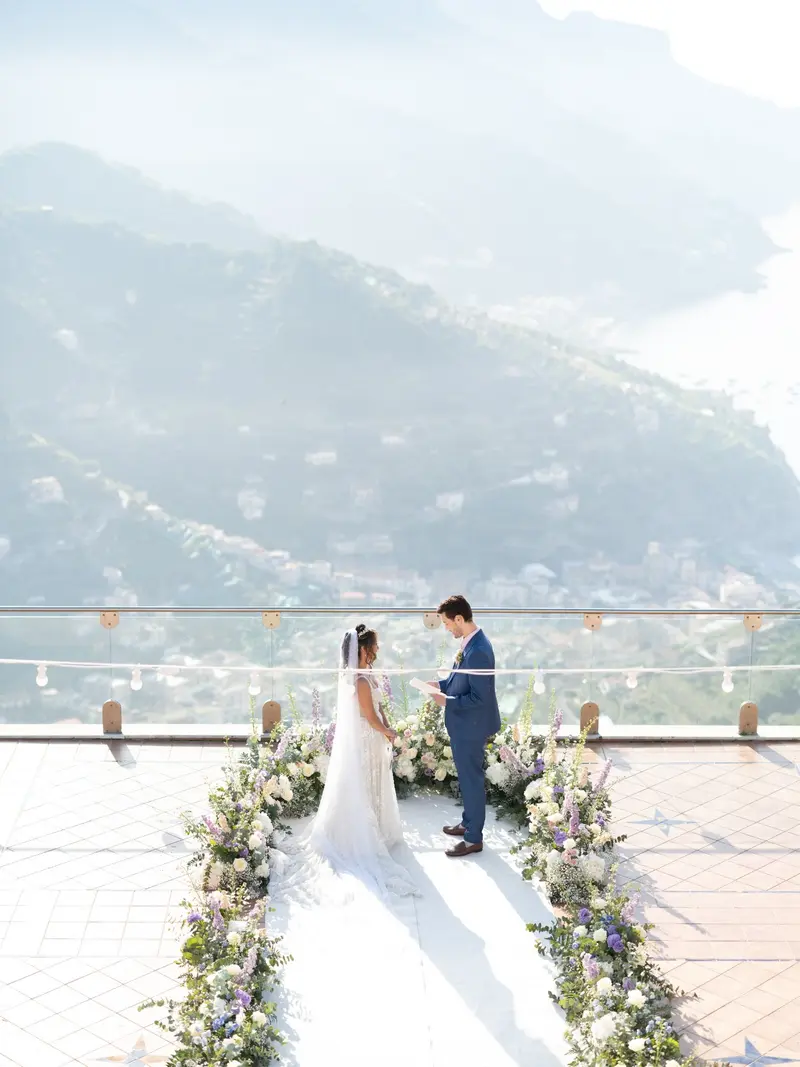
The Amalfi Coast is the opposite condition and she works it constantly. Villa Cimbrone at Ravello, Villa La Rondinaia, Palazzo Avino, Villa Eva. Everything that ends up at a Ravello wedding has come up the coast road, on a schedule, past everyone else trying to do the same thing on the same Saturday in June. Her film of a Palazzo Avino wedding and her film of Villa La Rondinaia are both on her own channel, and both show the same thing once you know to look for it: dinner running properly on a site where nothing can be delivered late.
Tuscany is where the volume is. Relais Mastrojanni in the Val d'Orcia, Borgo Santo Pietro, Villa La Selva, Villa le Fontanelle outside Florence. The register there is long light and longer lunches: a couple walking a vineyard row before dinner, a ceremony held among cypresses, an evening that starts late and does not need spectacle to carry. Puglia and Sicily are the newest and, on the evidence, the most interesting, because they are the places where she has the least inherited style to borrow.
⤢
⤢
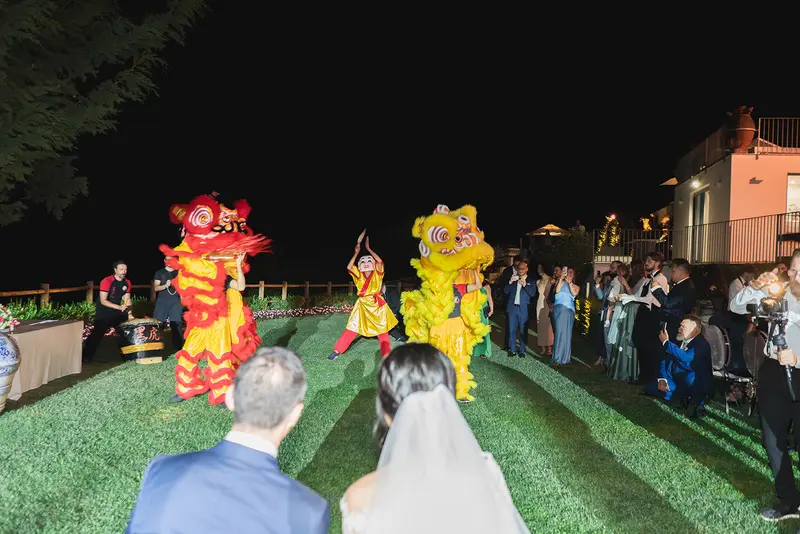
There is a page on her site that is worth reading in full, and it is the one about ceremonies. It lists what she plans: Catholic, Protestant and Orthodox Christian weddings. Jewish weddings with the chuppah, the ketubah, the glass and kosher catering. Muslim nikah and walima. Hindu weddings with haldi, mehndi and saptapadi. Sikh anand karaj with langar. Buddhist, Zoroastrian, Baha'i and Shinto. Interfaith. Humanist. Civil, with the bureaucratic process foreign couples need in order to be legally married in Italy, which is the part that quietly wrecks timelines when nobody has owned it.
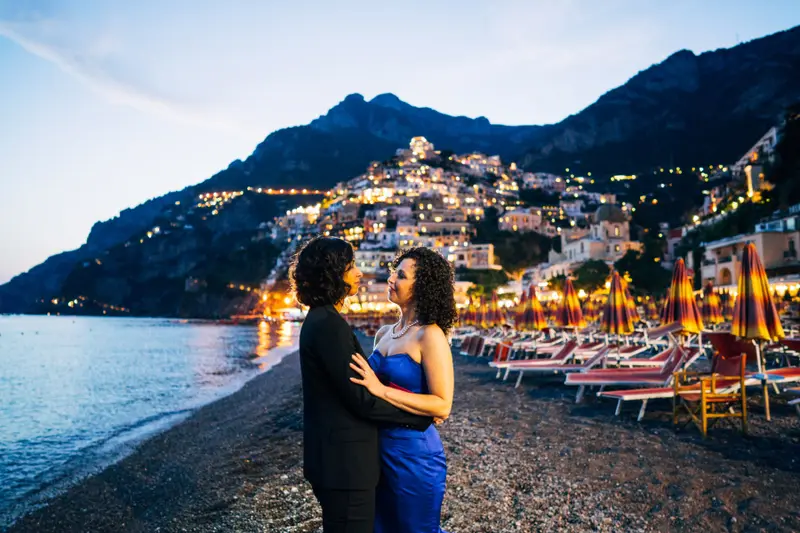
Same-sex weddings appear in that list, in the same tone as everything else, without a separate heading and without being turned into a position. Inclusivity is one of the nine values on her site, sitting between sustainability and pragmatism. The corroboration is in the portfolio rather than in a campaign: two grooms in an olive grove in Tuscany, burgundy and black tie, published alongside everything else.
"No distinctions, no judgments, only love matters, whatever form it takes."
Seven of her films are worth twenty minutes on their own, because film is harder to stage than a photograph. Villa del Balbianello on Lake Como. Villa Cimbrone and Villa La Rondinaia and Palazzo Avino on the Amalfi Coast. Villa le Fontanelle outside Florence. A Pakistani wedding in Tuscany. A private event at Portofino. Seven venues, six of them among the most contested addresses in Italy, and the through line is not the flowers but the running order: guests arriving in sequence, dinner served on a terrace that had to be built up that morning, an evening that keeps moving. A photograph shows you a table. A film shows you whether the day worked.
The editorial record is real and checkable. A wedding she planned in Sicily, at Dimora delle Balze, was published by Vogue France. Others have run in Carats and Cake, Wedding Sparrow, The Wed and Wed Vibes. She is a member of the Accademia Italiana Galateo, which is a detail that would be decorative anywhere else and is not here, because protocol and etiquette are load-bearing when you are seating four nationalities and two faiths at the same dinner.
Aboard a wooden launch, the coast behind them
The reviews are the other kind of evidence and they read consistently. Karine and Ibrahima wrote after an autumn wedding in Tuscany that everything was perfect from their first exchanges to the last moment at Borgo Casabianca. Gabriella and Colby wrote that their location was somewhere she had not worked before and that she pulled it off effortlessly, which is a better test than a repeat venue. Sydney and Michael thanked her for a year and a half of coordination. What recurs is not the flowers. It is availability, communication, and someone still being there at the end.
Two names keep appearing in those messages: hers, and Pascale's. That is what a practice of this size looks like from the inside, and it is the argument for the ten-a-year ceiling stated in commercial terms. She also tells couples what she wants from them, which is unusual: hold the venue twelve to eighteen months out, and if you can manage two trips to Italy, make one for venues and one for the tasting and the trial. Her suppliers are offered rather than imposed. If you already have a photographer you want, she will work with them inside the venue's rules.
So the fit is easy to describe. A couple marrying in Italy from somewhere else, who want the person who took the enquiry to be the person directing the day, who would rather know the fee before the first call than after the third, and who want a wedding that looks like the place it is happening in rather than like the last one. Ask about the date before you ask about anything else. There are only ten of them, and she says so in public.
Credits
Planning and design
Elisa Prati Wedding Italy
Films
Elisa Prati Wedding Italy
Written by
The LWD Edit
The editorial team at Luxury Wedding Directory, profiling the world's finest wedding venues and creatives.
Filed under
Share
Elisa Prati Wedding Italy · Enquire
Enquire with Elisa Prati Wedding Italy
Send an enquiry and our wedding team will connect you with the venue.
We use essential cookies to make our site work, and optional cookies to personalise content and improve your experience. By clicking Accept All, you agree to our use of cookies. · Cookie Policy