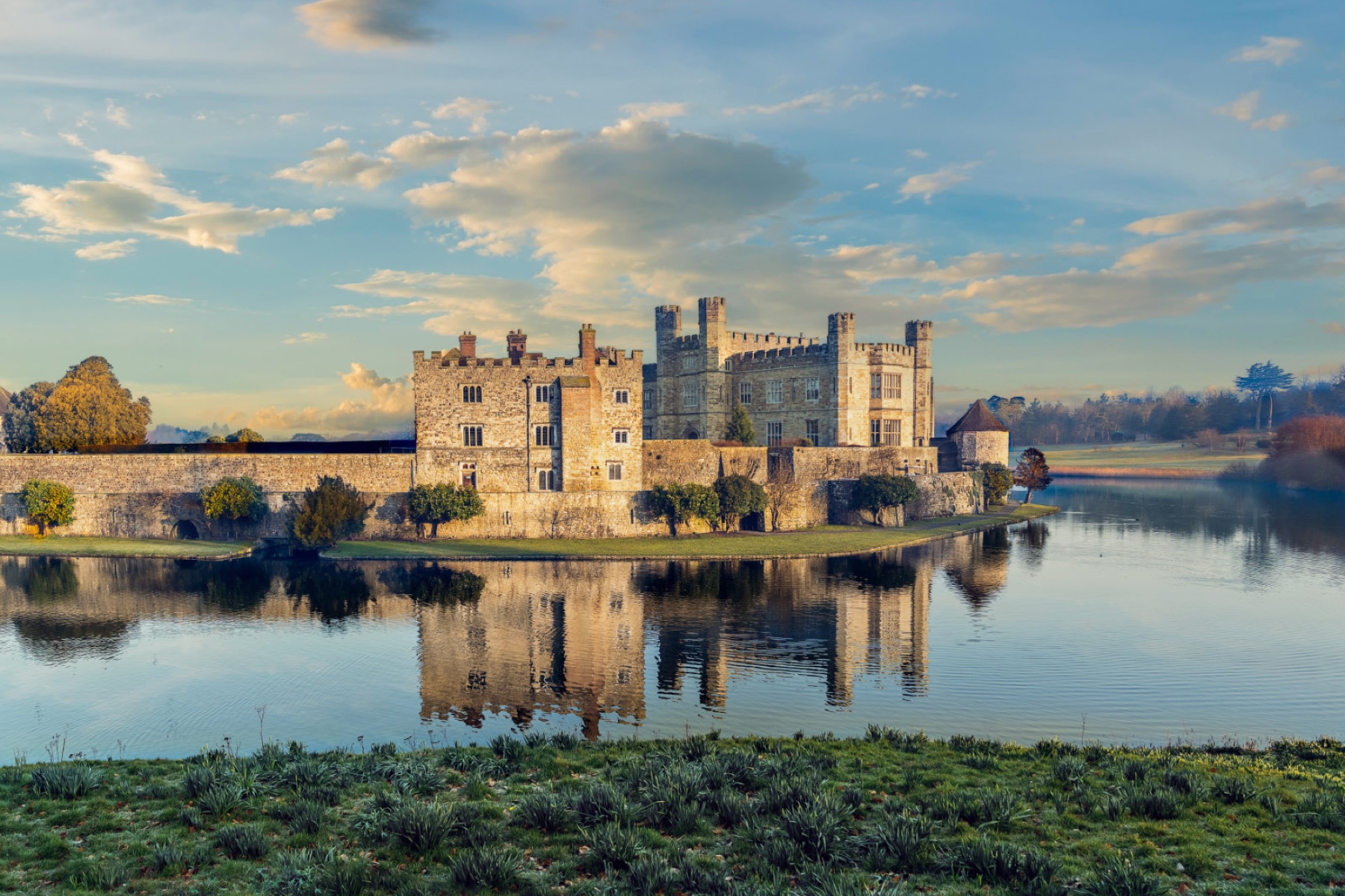
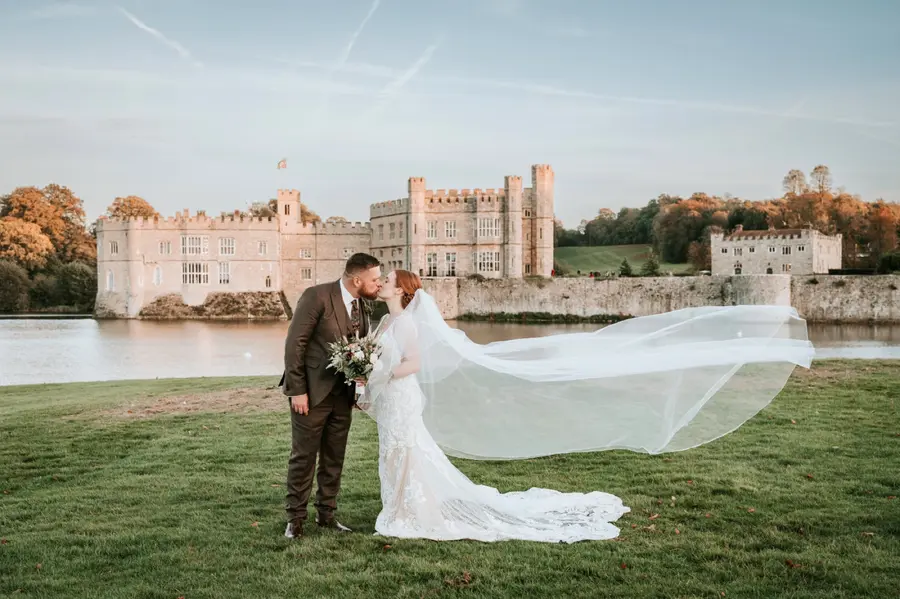
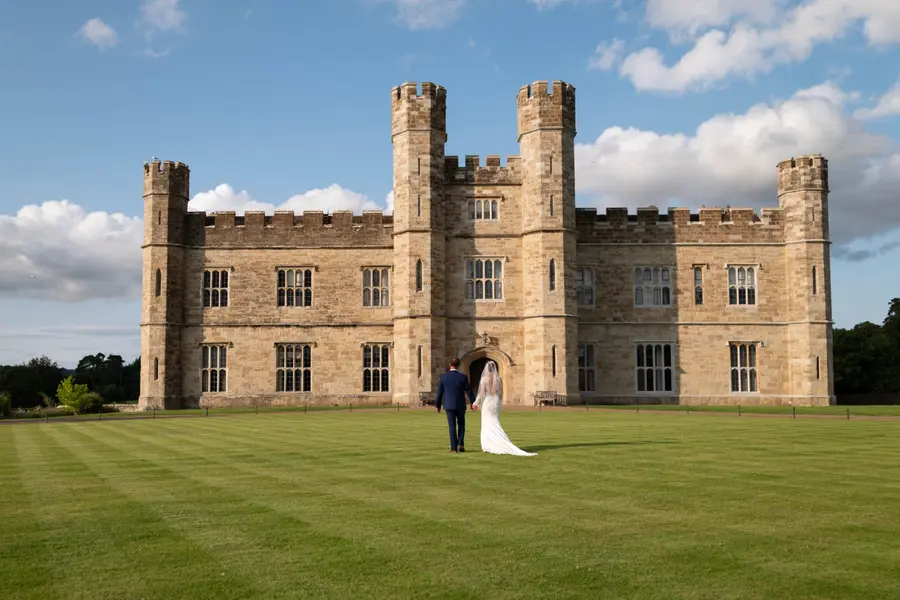
Some weddings are defined by a place, and Leeds Castle is unmistakably one of them: a medieval castle set on two small islands in the middle of a Kentish lake, home to six queens of England across nine hundred years, and called, for almost as long, the loveliest castle in the world. You cross the water to reach it, the way every visitor has since the Normans, and by the time you arrive something has already shifted. This is not a venue that happens to be historic. It is a place where the history is the fabric of every room.
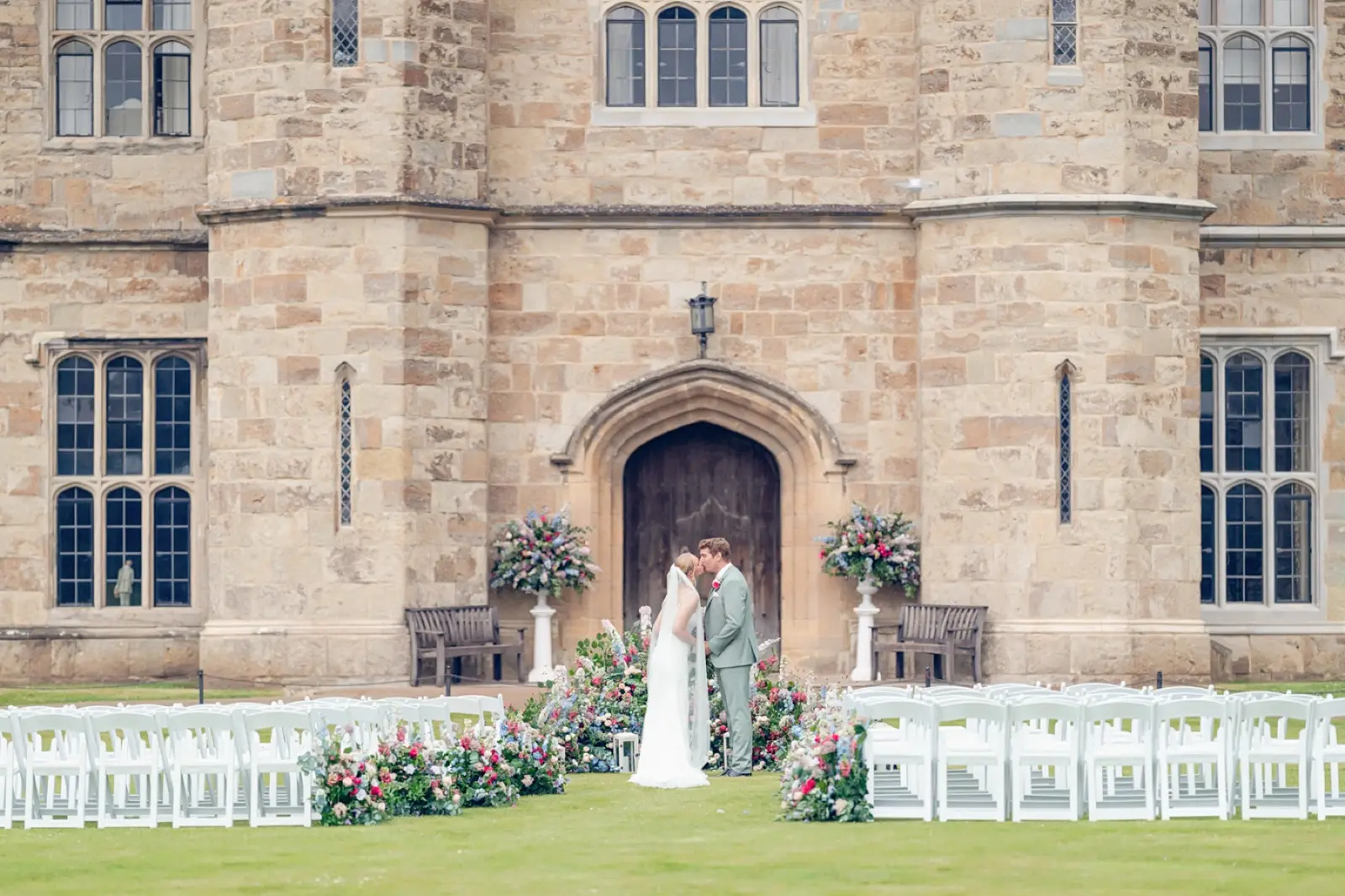
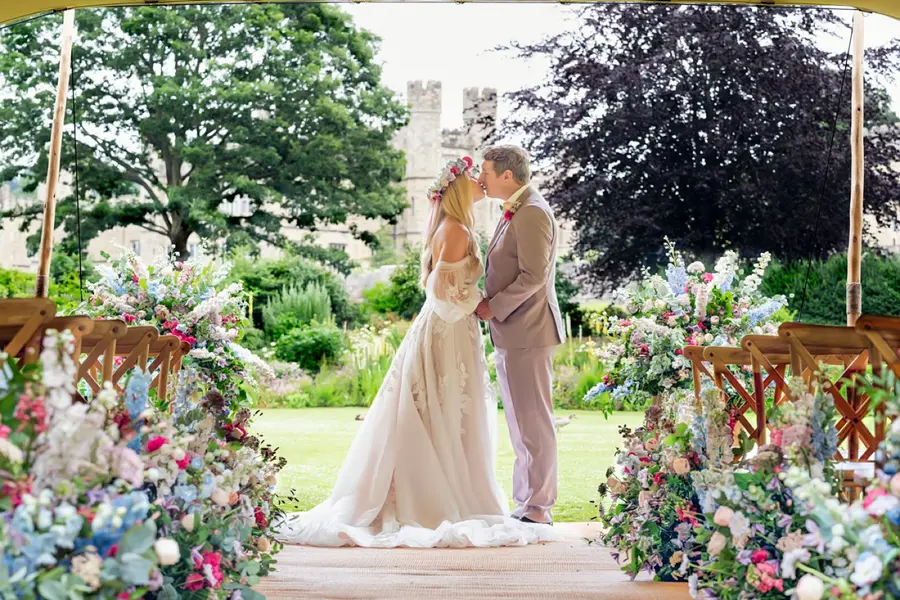
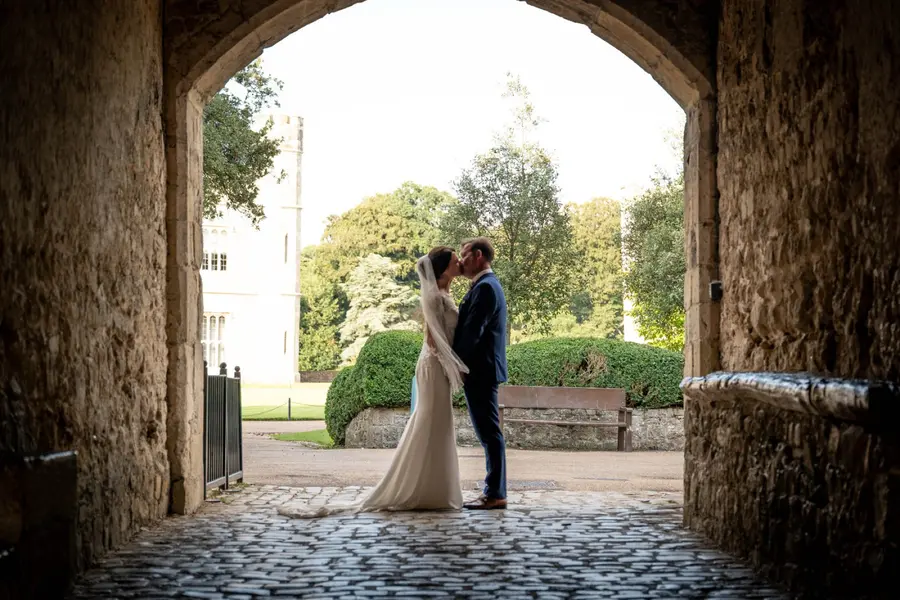
A Couple Beneath a Floral Arch at Leeds Castle, a Cultural Celebration
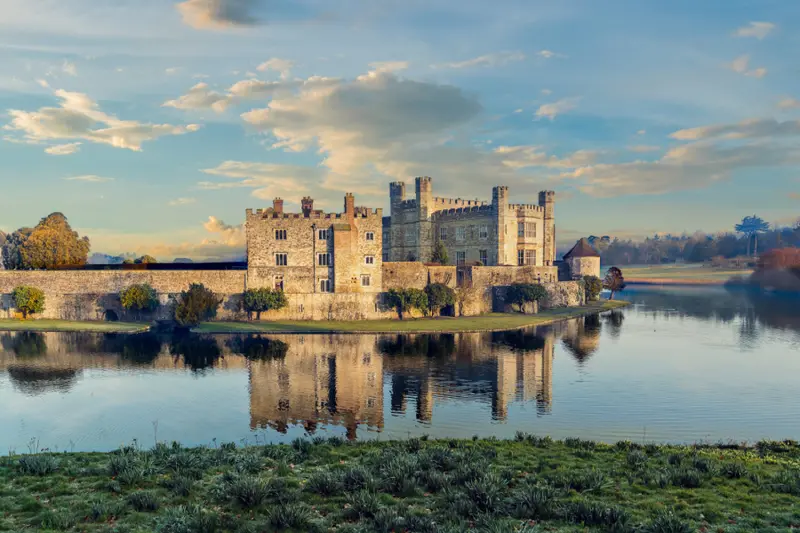
The castle stands on two islands within a twelve-acre moat lake, in five hundred acres of parkland in the heart of the Kentish countryside, about seventy minutes from London. Its story begins around 857 AD with a Saxon manor; by 1119 it had become a Norman stone fortress, and by 1278 it had passed to King Edward I, whose queen, Eleanor of Castile, made it a royal residence. For three centuries the crown held it, and six medieval queens of England lived within its walls.
Those six queens are the spine of the castle's story: Eleanor of Castile, the first, given the castle by Edward I in 1278; Margaret of France; Isabella of France, who famously besieged the castle in 1321 when Lady Badlesmere denied her entry; Anne of Bohemia; Joan of Navarre; and Catherine de Valois. In 1519 Henry VIII transformed the castle for Catherine of Aragon, and it has carried the Tudor stamp of that remodelling ever since. To marry here is to hold a ceremony in rooms that have borne the weight of English royalty for seven hundred years.
The castle's second life began in 1926, when Olive, Lady Baillie, one of the wealthiest women in England, bought the neglected estate and reinvented it as the most glamorous private house in the country. She commissioned interiors from Armand-Albert Rateau and Stephane Boudin and filled the house with the century's most glamorous guests: Edward VIII, George VI, Douglas Fairbanks, Charlie Chaplin, Errol Flynn. On her death in 1974 she bequeathed the entire estate to the Leeds Castle Foundation, the charitable trust that owns and runs it today, so that a wedding here contributes directly to the preservation of one of England's most significant heritage properties.
The castle's public life did not end with Lady Baillie. Under the Foundation it opened to visitors, the gardens in 1975 and the castle in 1976, and today receives around half a million people a year. It has also kept a place on the world stage: in July 1978 it hosted the private talks that preceded the Camp David Accords, and in 2004 it held Northern Ireland peace negotiations led by Tony Blair. The rooms that take a wedding breakfast have, within living memory, held conversations that changed history.
Three things set the castle apart, and no other in England can claim them at once. The setting: a castle on an island in a twelve-acre moat, in five hundred acres of parkland, seventy minutes from London. The history: royal history across nine centuries, six queens and Henry VIII, without the amusement-park trappings of the more commercialised heritage venues. And the flexibility: five distinct wedding spaces on one estate, from a wedding breakfast for sixteen to a marquee for five hundred, with accommodation that puts your guests inside the history rather than in a hotel three miles away.
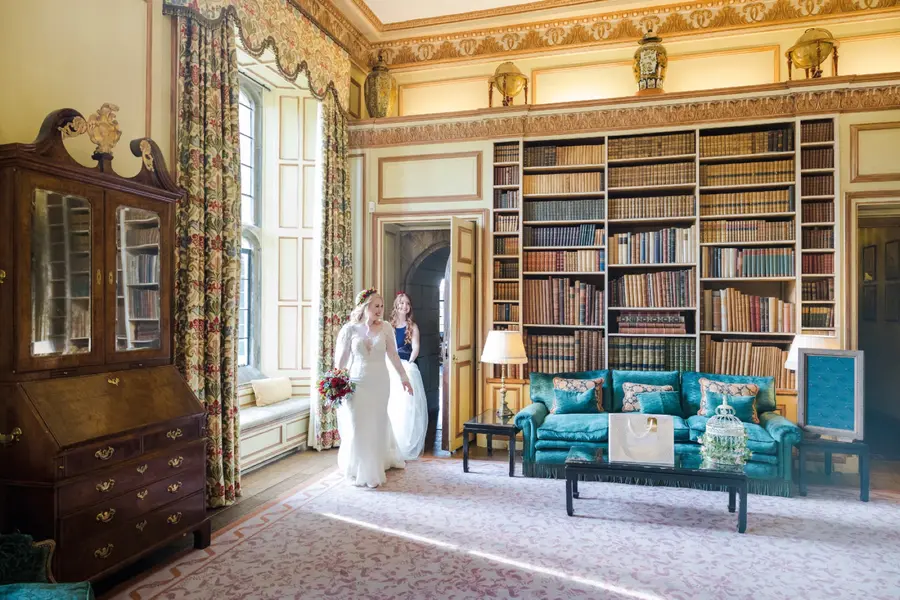
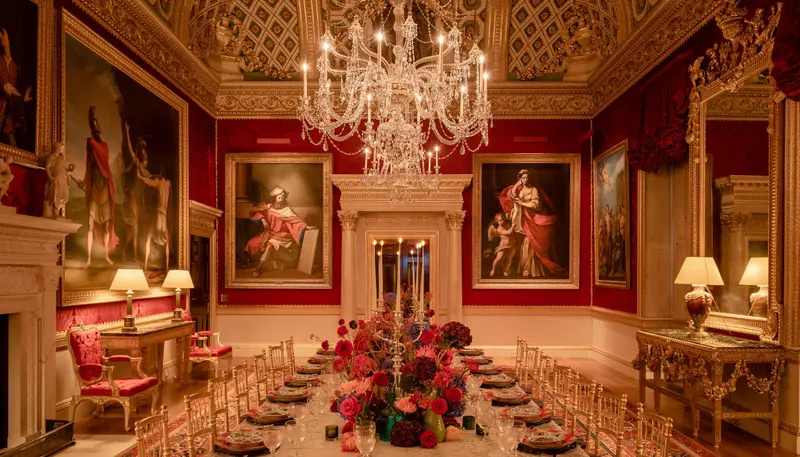
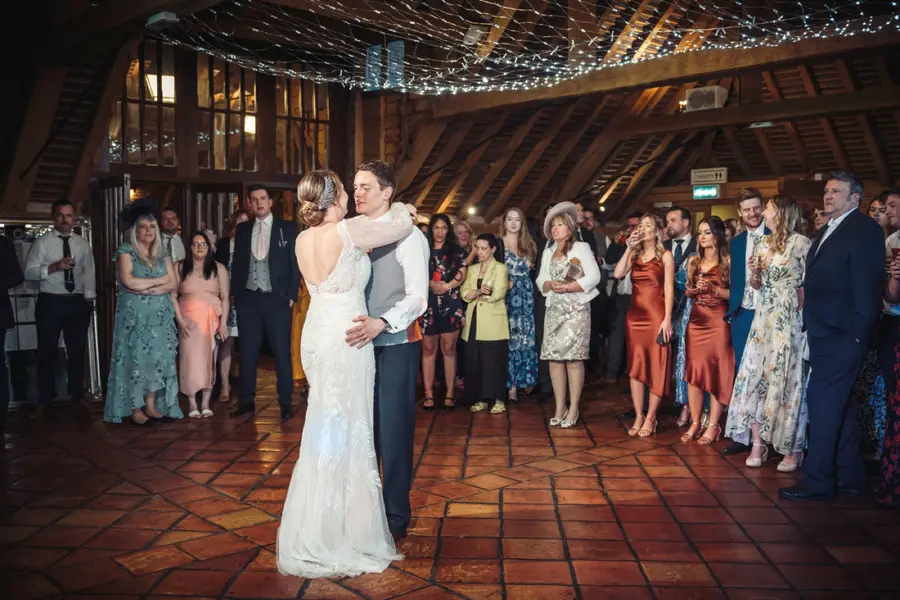
For a wedding, the castle opens across five distinct, exclusive-use spaces, and the range between them is deliberately wide. The castle itself is the principal setting: a civil ceremony for up to a hundred guests in rooms associated with six queens, a wedding breakfast for a hundred in the Grand Salon and the Thorpe Hall Drawing Rooms, and an evening reception for a hundred and twenty, the twelve-acre moat visible from the windows of every reception room, the evening running to midnight.
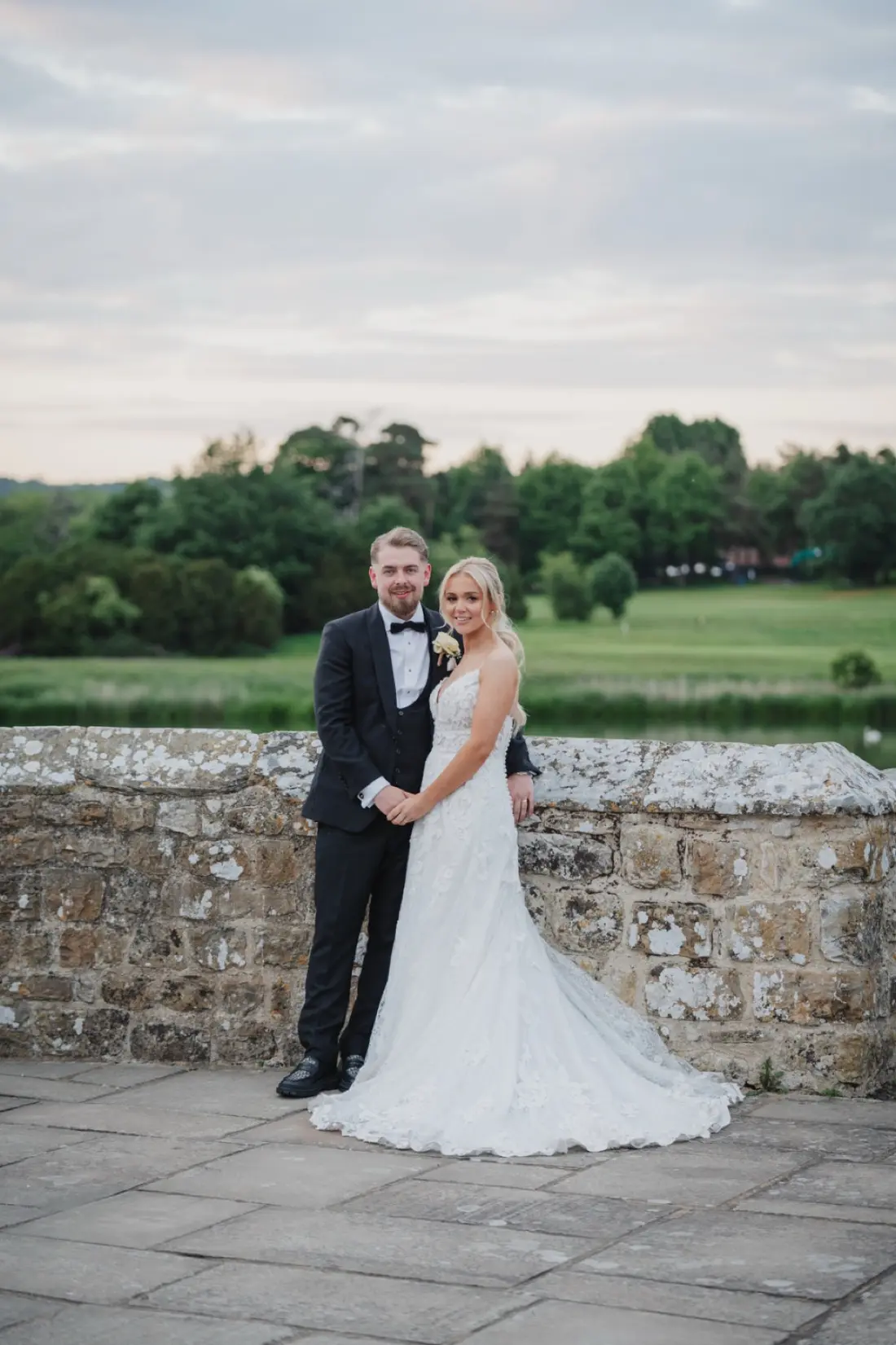
Leeds Castle at Sunset, a Couple and the Castle in Silhouette (Photo: Steven Brooks Photography)
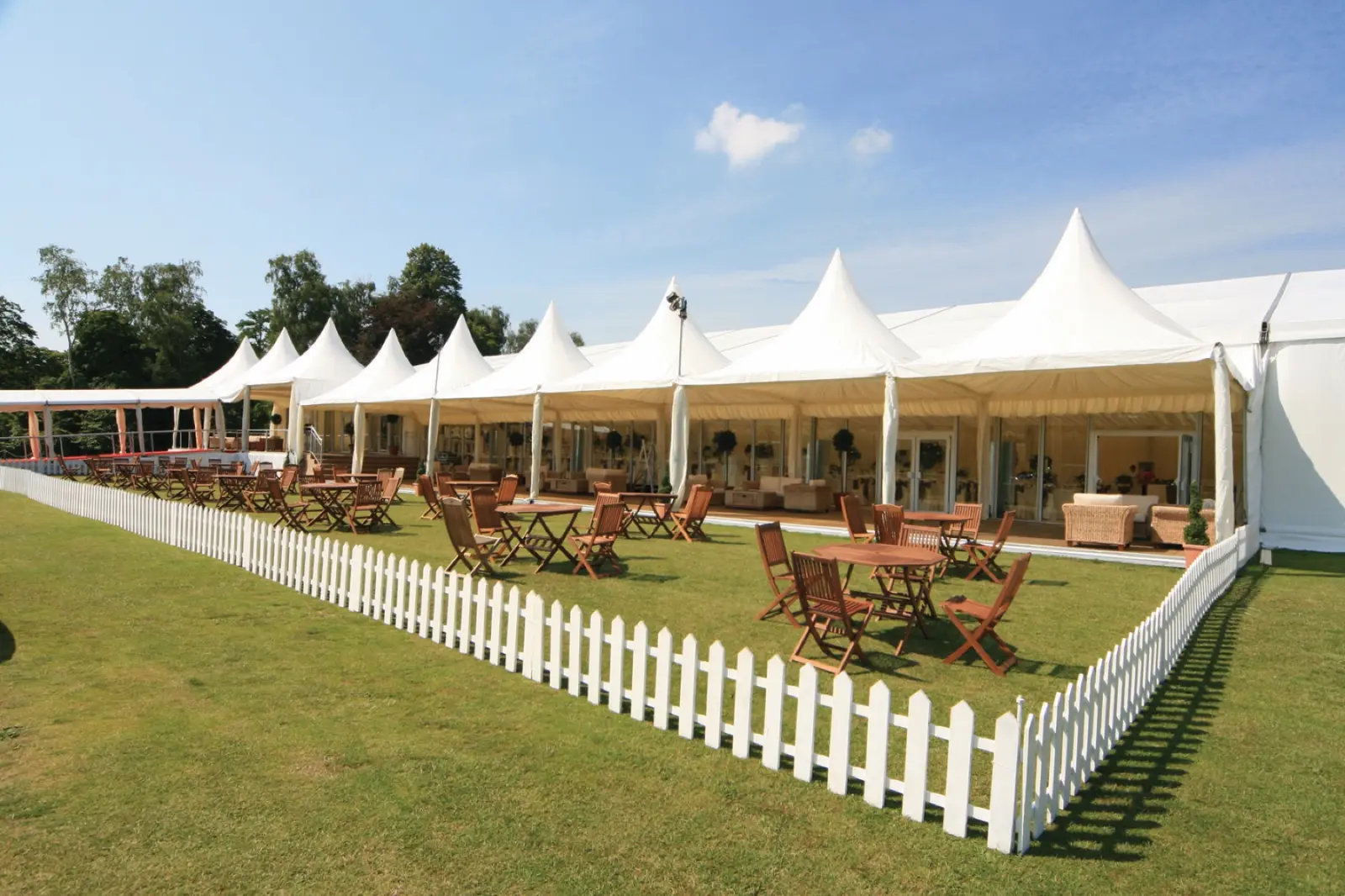
Beyond the castle, the Maiden's Tower offers a more intimate island setting, with a ceremony for up to eighty and its own private gardens. Battel Hall is the most private of all, a secluded medieval manor house with a walled garden, taken in its entirety for a ceremony and wedding breakfast of just sixteen, one of the most intimate exclusive-use weddings in England. The Fairfax Barn takes a relaxed evening reception of a hundred to a hundred and eighty from six until midnight. And on the estate lawns, a marquee accommodates two hundred to five hundred guests for the grandest celebrations.
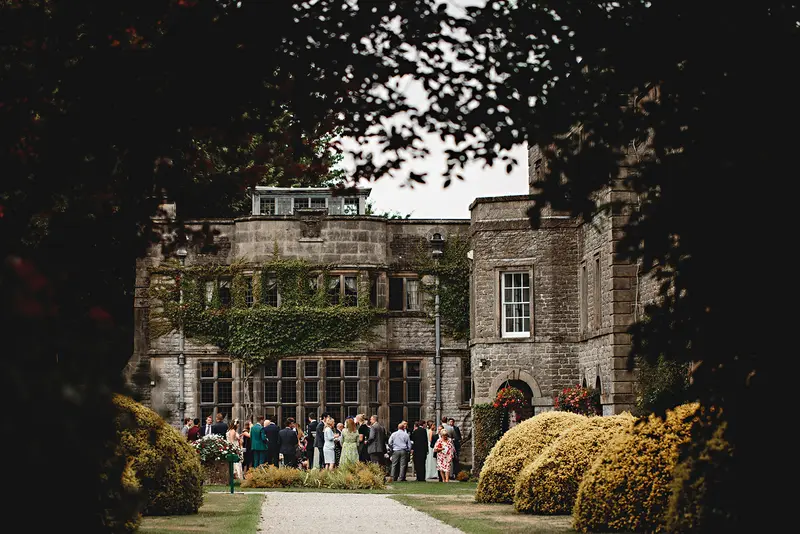
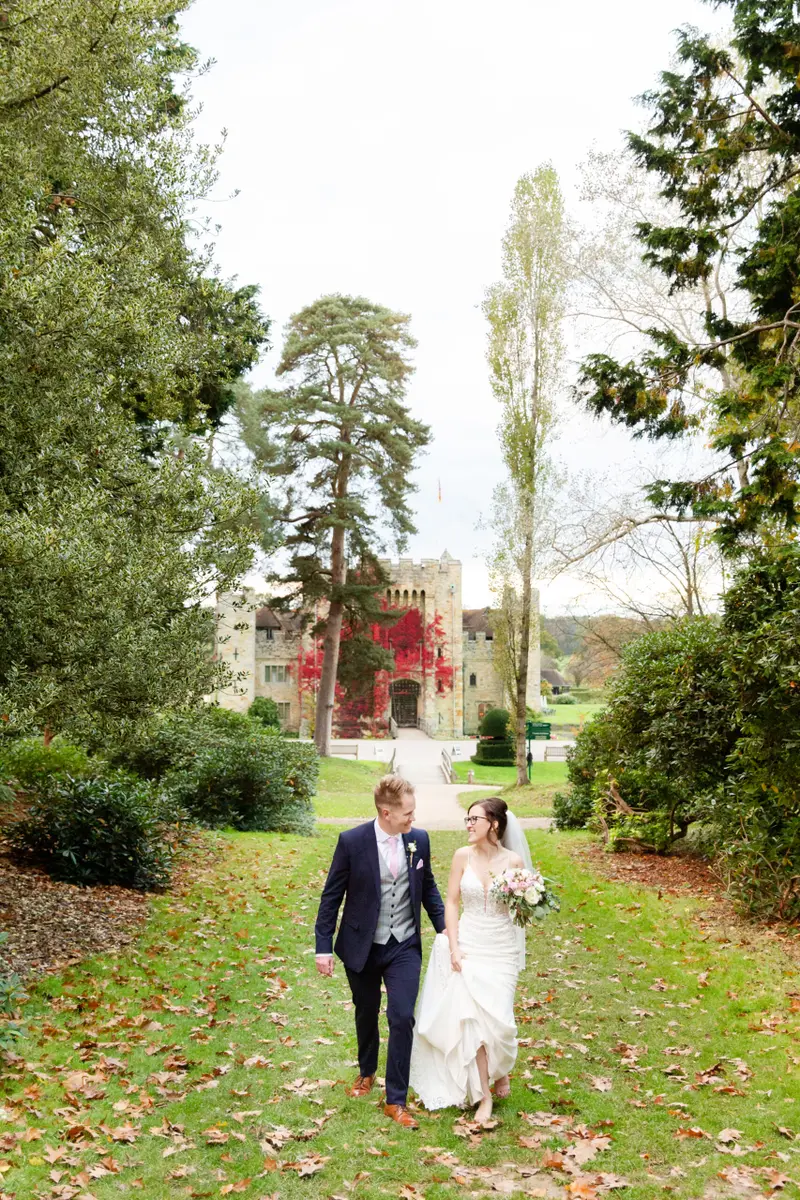
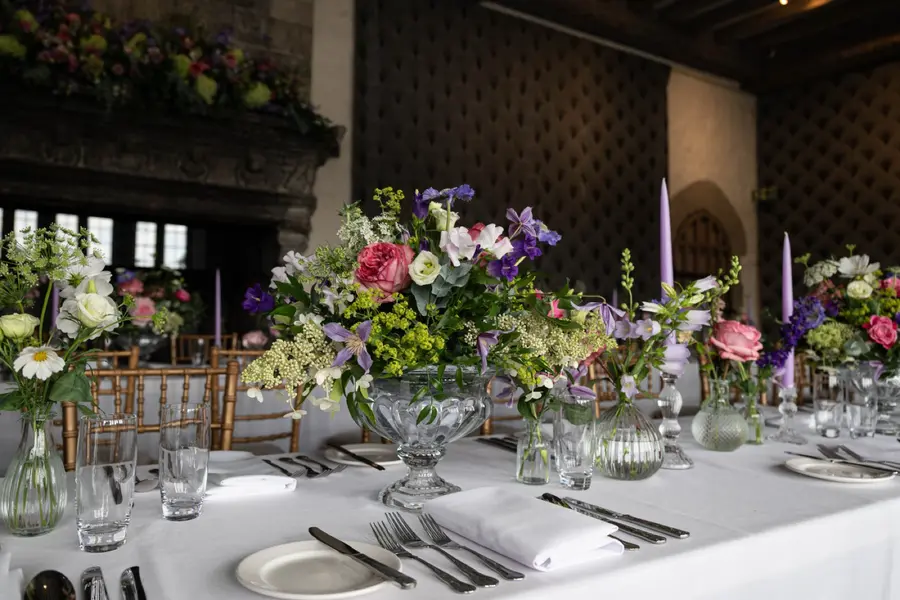
The shape of the day follows the castle. Couples marry in the Grand Salon and the Drawing Rooms beneath windows that look straight onto the water, or, on a fine day, outdoors on the lawns with the castle behind and the moat all around. The wedding breakfast follows in the historic rooms, the reception runs into the Kentish night, and the evening closes with sparklers and torchlight against nine hundred years of stone. A dedicated Leeds Castle coordinator holds the whole of it together, with a handpicked network of florists, photographers and entertainers to draw on.
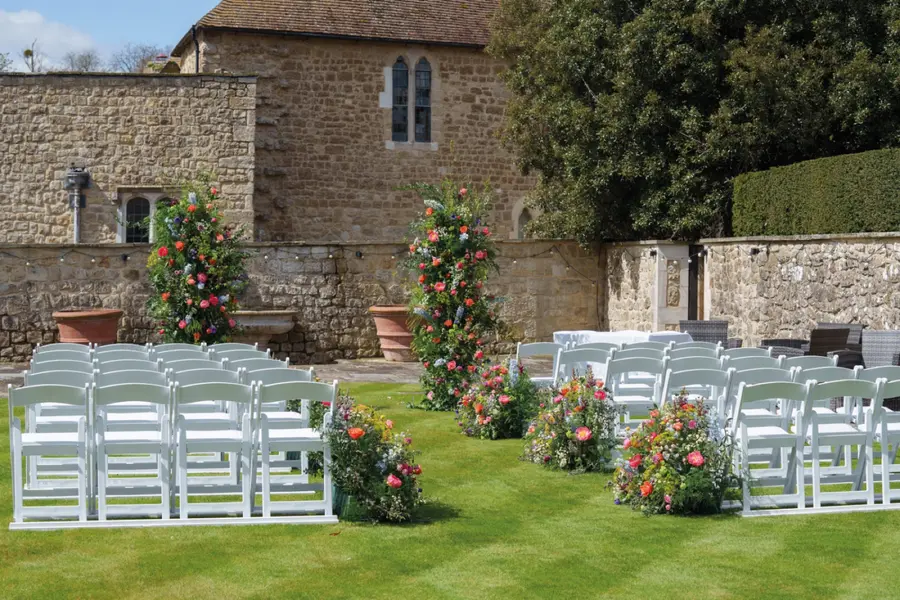
Outdoors, the estate offers several licensed ceremony settings beyond the castle rooms: the Pavilion Lawn and the Croquet Lawn each hold a hundred guests, and the marquee sites open the grounds to five hundred. For the photographs, the whole five hundred acres are in play: the moat bridges, the Culpeper Garden in bloom, the Lady Baillie Mediterranean terraces above the water, and the yew maze. Late spring and summer bring long golden evenings; autumn brings colour and a morning mist off the moat; a winter wedding brings candlelight and bare trees mirrored in the water.
"Few wedding venues in the world can offer a ceremony inside walls where Catherine of Aragon once lived, and a reception in a room with the moat at every window."
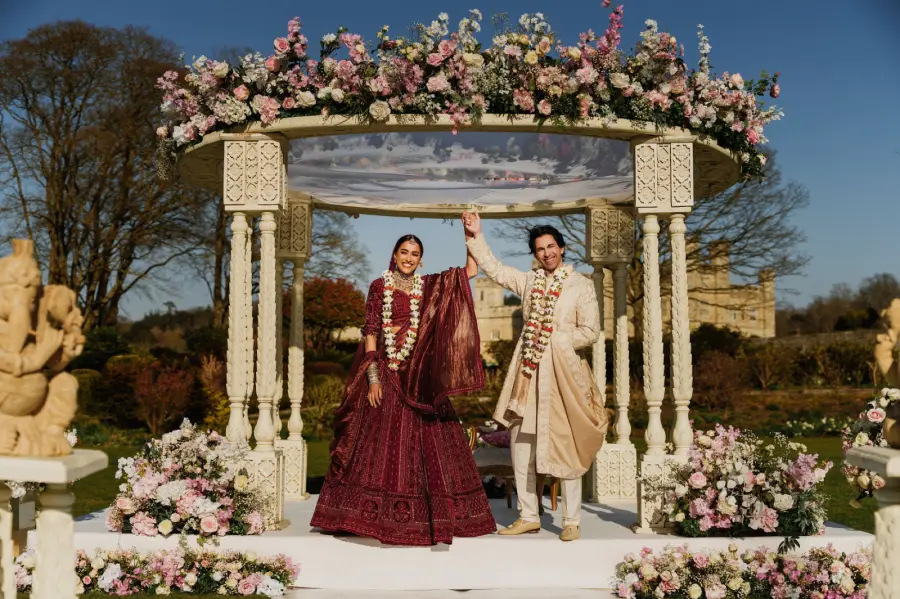
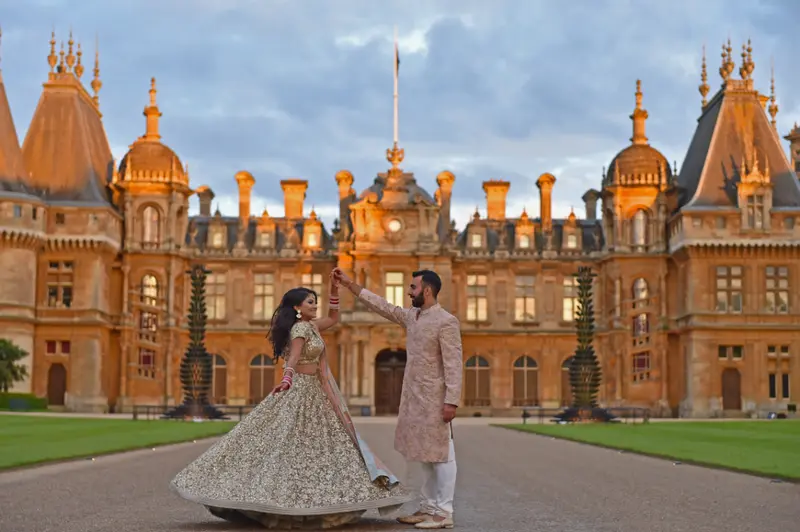
That flexibility makes Leeds Castle one of the great English settings for cultural and Asian weddings. The estate lawns take a marquee for up to five hundred, and the castle's handpicked network of preferred caterers composes Indian, Lebanese, Pan-Asian and Middle Eastern banquets to match. The wedding team builds bespoke packages for cultural celebrations, so a multi-day Indian wedding or a Lebanese banquet has the same nine centuries of stone for a backdrop as an intimate English ceremony for sixteen.
Catering runs through that preferred network rather than a single in-house kitchen, which means the menu is built around the couple rather than constrained by one operation: traditional British country house dining, seasonal Kentish tasting menus, cultural banquets, contemporary canapes. Every caterer on the list has been vetted by the castle and knows the practicalities of each space. Lady Baillie's founding principle, that any guest of the castle should receive the finest food and the highest service, is the standard each one is held to.
The Stay
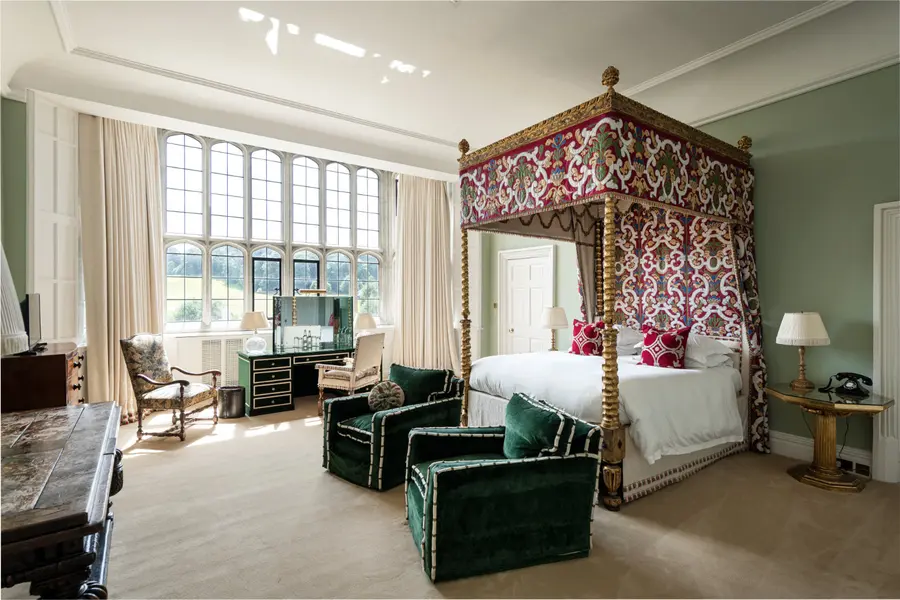
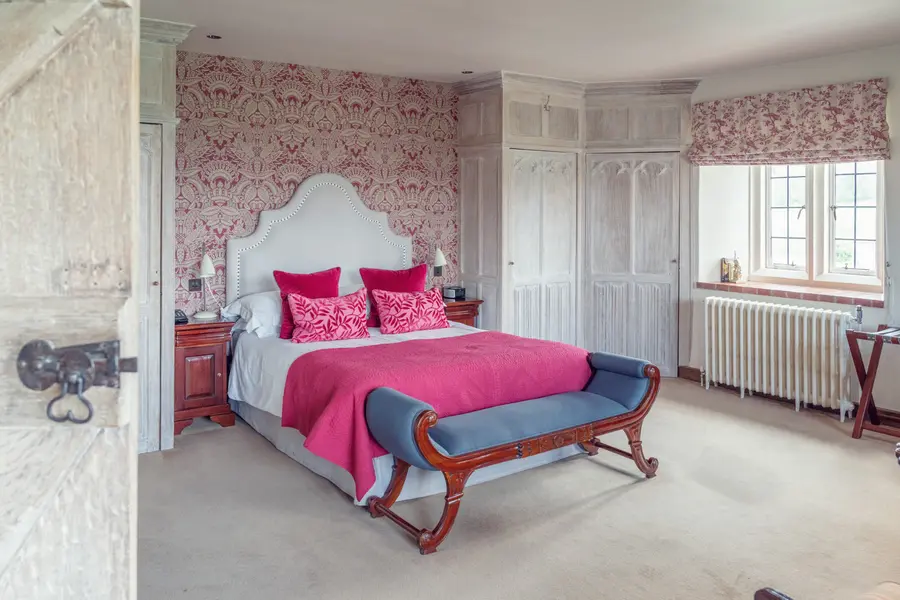
The wedding party stays on the estate. Within the castle, on Castle Island, the Castle Wedding package opens ten bedrooms rarely available to the public: one Castle Bridal State, two Castle Classic and seven Castle State rooms, where medieval queens once slept, with the moat at the window. Beyond the castle lie the Maiden's Tower Deluxe Double, the Stable Courtyard bed and breakfast, the Lakeside Lodges on the water's edge, and seven self-catering cottages for two to twelve guests across the five hundred acres, so the whole party wakes together inside the history. Overnight stays include daytime castle admission and out-of-hours access to the grounds.
The estate around the wedding is a world in itself. Falcons fly daily over the parkland from the castle's falconry centre. A maze of two thousand four hundred yew trees, planted in 1988, hides an underground grotto at its heart. There is a nine-hole golf course, a Go Ape treetop course, Segway tours, a ferry across the lake, and the Dog Collar Museum, which holds what may be the world's only collection of historic dog collars. For the days around the wedding, guests have five hundred acres of Kentish parkland, gardens and water to explore.
For all its seclusion, the castle is easy to reach. It sits at Broomfield, seven miles southeast of Maidstone, five minutes from junction 8 of the M20. Direct trains from London Victoria reach Bearsted, a short taxi away, in about seventy minutes; Gatwick is roughly forty-five minutes by road, Heathrow about ninety. It is close enough for a one-day London celebration and secluded enough to feel like another country entirely.
A Ceremony Set Before the Castle, White Chairs on the Lawn, Leeds Castle
A Wedding at Leeds Castle
The loveliest castle in the world, yours for the day. Leeds Castle is one of England's most extraordinary heritage wedding venues, and one of its most flexible, equally at home with an intimate sixteen at Battel Hall, a grand castle reception, or a five-hundred-guest cultural celebration on the lawns. Nine centuries of history, a moated island, five hundred acres of Kent, and a single perfect day. Begin with the Leeds Castle wedding team, or enquire through Luxury Wedding Directory.
- Venue
- Leeds Castle, Broomfield, Maidstone, Kent ME17 1PL
- Images
- Courtesy of Leeds Castle
The editorial team at Luxury Wedding Directory, profiling the world's finest wedding venues and creatives.
Leeds Castle · Enquire
Enquire with Leeds Castle
Send an enquiry and our wedding team will connect you with the venue.